Vacuum Lifters in Glass Handling: Advantages and Practical Applications
In the glass processing industry, safe and efficient material handling plays a crucial role in productivity, product quality, and workplace safety. As glass panels continue to increase in size, weight, and value, traditional manual handling methods are becoming less suitable for modern production environments. As a result, vacuum lifters have become an essential solution for glass handling in many glass factories.
What Is a Vacuum Lifter?
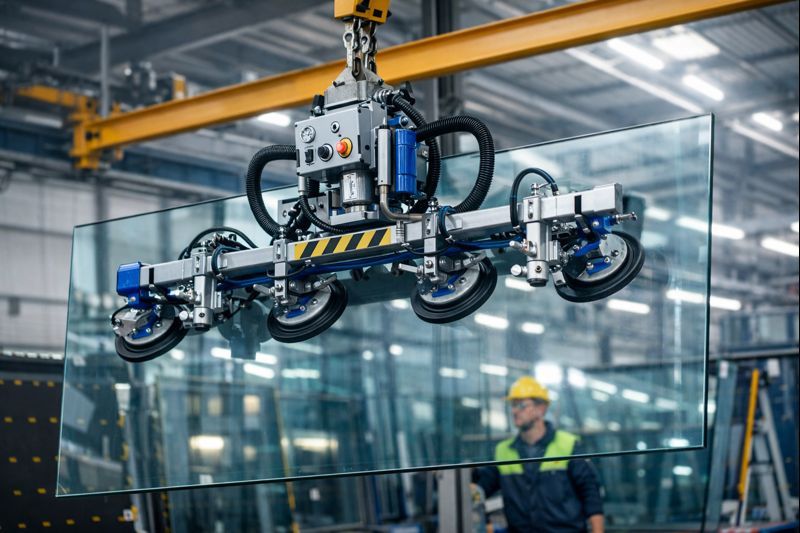
A vacuum lifter is a handling device that uses vacuum suction cups to grip glass surfaces securely. By creating negative pressure between the suction cups and the glass, the system allows operators to lift, move, rotate, and position glass panels safely and accurately. Vacuum lifters are widely used in glass storage areas, cutting workshops, insulating glass production lines, and loading or unloading operations.
Key Advantages of Vacuum Lifters in Glass Handling
1. Improved Workplace Safety
Handling glass involves potential risks due to sharp edges and heavy weight. Vacuum lifters significantly reduce direct manual contact with glass, helping to minimize the risk of cuts, strains, and workplace injuries. Stable suction and controlled movement allow operators to handle large glass panels more safely and with greater confidence.
2. Reduced Glass Breakage
Uneven force distribution during manual handling is one of the main causes of glass breakage. Vacuum lifters apply uniform suction across the glass surface, reducing stress concentration and lowering the risk of cracks or breakage. This helps manufacturers reduce material waste and improve overall production efficiency.
3. Increased Handling Efficiency
Compared with manual handling, vacuum lifters enable faster and more consistent glass handling operations. Large glass panels that once required multiple workers can often be handled by one or two operators. This improves workflow efficiency and reduces labor dependency, especially in high-volume production environments.
4. Versatility for Different Glass Types
Modern vacuum lifters are designed to handle a wide range of glass types, including float glass, laminated glass, coated glass, and insulating glass units. Adjustable suction configurations and lifting capacities make vacuum lifters suitable for different sizes, thicknesses, and weights, offering flexibility for diverse production requirements.
5. Enhanced Precision and Control
Vacuum lifters provide stable and precise control during lifting and positioning operations. This is particularly beneficial for processes that require accurate placement, such as loading glass onto cutting tables or aligning panels in insulating glass production lines. Improved control helps enhance product quality and reduce operational errors.
Applications of Vacuum Lifters in Glass Factories
Vacuum lifters are widely used throughout different stages of glass processing. They assist with unloading glass sheets from storage racks, positioning glass on cutting tables, and safely transferring glass between workstations. Their flexibility and reliability make vacuum lifters an indispensable part of modern glass handling systems.
Conclusion
As the glass processing industry continues to move toward larger glass sizes and higher efficiency, vacuum lifters play an increasingly important role in glass handling operations.
By improving safety, reducing breakage, and increasing productivity, vacuum lifters offer a reliable and practical solution for glass factories seeking to optimize their handling processes.